


About us
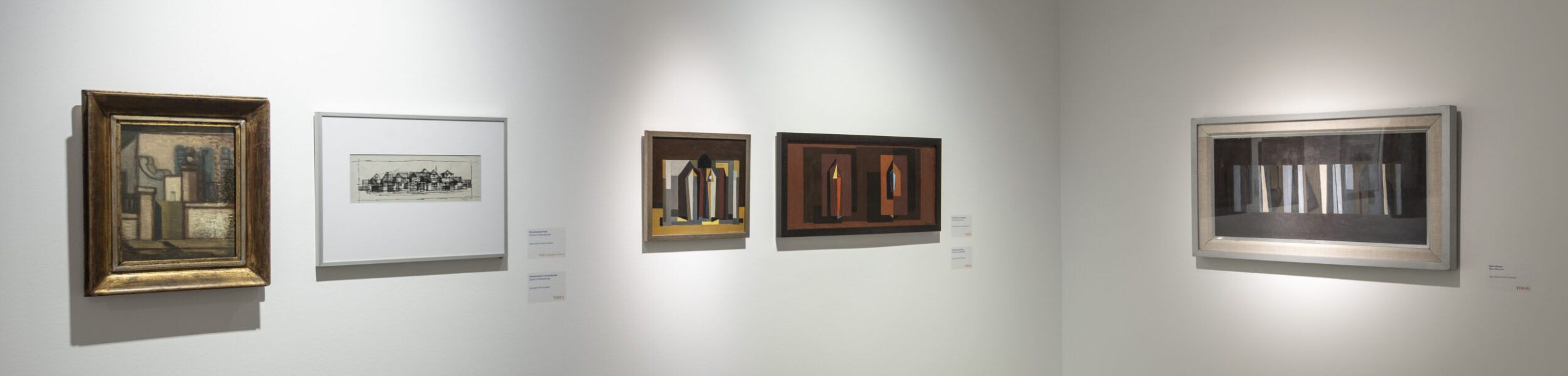
SZENTENDRE AND MODERN FINE ART
The history of Szentendre, a small town on the banks of the Danube near Budapest, became intertwined with modern fine arts in 1890. In that year, the young Károly Ferenczy (1862–1917), who had just finished his Western European studies, settled in Szentendre with his family. A decade and a half later, when he won the grand gold medal at the 6th Venice Biennale, he was considered by professional opinion to be the best Hungarian painter. In the same year, Noémi Ferenczy (1890–1977), the creator of modern Hungarian tapestry art, was born, as was her brother, Béni Ferenczy (1890–1967), the school-creating grandmaster of Hungarian sculpture and medal art. At the turn of the century, Budapest’s dominance in fine arts was shaken, one of the spectacular signs of which was the establishment of new and new artist colonies in the countryside.
At the end of the twenties – with the participation of Jenő Paizs Goebel (1896–1944) among others – an artists’ colony was established in Szentendre, which, although it could not gain the same recognition as the exemplary ones in Nagybánya, Szolnok or Gödöllő, provided motivation for many significant artists to move to the city. This is how Béla Iványi Grünwald (1867–1940) came to Szentendre, a little later Jenő Barcsay (1900–1988), and then János Kmetty (1889–1975), three internationally significant creators of Hungarian fine arts. In the mid-thirties, Dezső Korniss (1908–1984) and Lajos Vajda (1908–1941) arrived in the city – the Szentendre program they developed is one of the most important manifestos of modern Hungarian art. Vajda, who died young, has not only been a defining point of reference for Hungarian fine arts for more than half a century, but also one of the most significant in terms of his influence. Vajda’s intellectual circle included Imre Ámos (1907–1944), the domestic originator of modern visionary painting, Anna Margit (1913–1991), who renewed her art several times, and Endre Bálint (1914–1986), who created a lasting impression in several avant-garde stylistic trends – the latter also participated in the activities of the progressive European School that began after the war, but was thwarted by political power.
Even before the war, the internationally renowned Béla Czóbel (1883–1976), whose artistic influence remained even in the communist era, moved to the city. The painting of Pál Deim (1932–2016), which began to develop in the late 1950s, was already based on the Szentendre tradition, just like the art of the sculptor Ádám Farkas (1944). In 1968, young, largely self-taught artists – defying political expectations – created their own forum for their work under the name of the Szentendre Open-Air Exhibition, and then in 1972, the members of the circle established the Vajda Lajos Studio, which became a defining workshop of alternative Hungarian art for decades, with internationally significant artists such as Imre Bukta (1952) and László feLugossy (1947). In 1951, an independent museum was founded in the city, and in the 1970s, a system of so-called “small museums” and exhibition spaces was established alongside the Ferenczy Museum. The MűvészeMalom, which opened in 1999, joined them. Currently, the Ferenczy Museum Center (FMC) operates the city’s major fine arts exhibition venues and looks after its collection of more than ten thousand pieces based on the most important works of Szentendre art.
In Pest County, the staff of the Ferenczy Museum Center in Szentendre carry out the archaeological work required by the specialized authority’s position statements for investors and builders, so the archaeological collection of the Ferenczy Museum Center encompasses almost the entire territory of Pest County. The historical collection, which exceeds 30,000 pieces, is divided into two larger units: the historical documentation collection and the historical object collection. The documentation collection contains paper-based documents related to the history of Szentendre and its surroundings, as well as Pest County, from the 18th century onwards. In addition to the well-preserved military objects from the First World War, the material collection also includes 19th and 20th century furniture, clothing, household utensils, everyday and festive items and ornaments, from badges to typewriters and paintbrushes to the furnishings of a grocery store between the two world wars.
The ethnographic collection – which represents the lifestyle, material culture and folk art of the Hungarian, Serbian, German and Slovak population living in the county – has 9,000 pieces. The ethnographic material consists of several collection units: textile collection, ceramic collection, furniture, household and small crafts collection, folk religion and folk applied arts collection. The literary collection is a collection segment that is in its infancy and is open to the care of documents of literary-related oeuvres and events of literary significance found in the city and county.
MISSION STATEMENT OF THE FERENCZY MUSEUM CENTER
We consider it our task to make our institution a museum that is exciting, modern and open to the scientific and wider public. Our goal is to create a complex center of thought that is inclined to reflection, combining the continuous historiographical approach of scientific fields with the collection, processing and temporary exhibition activities.
Strengthening our work so far, we wish to operate as a research and creative center that, through its projects, relates to art not only with the convenience of subsequent filtering, but also as an initiating “partner”. Our task is to research, reinterpret, exhibit and make accessible the material and intellectual heritage found in our collections in a scientifically sound manner. Our task is to preserve, nurture and popularize the 110-year-old artistic tradition of Szentendre, the interesting and diverse history of its nationalities, to respond sensitively to changes in the city’s cultural and built heritage, to social movements, taking an active role in the protection of cultural heritage and shaping the future of Szentendre.
Our goal is to strengthen urban and regional identities. We consider it our mission, as a content provider, to support the collection, preservation, research, presentation, scientific definition and publication of cultural heritage assets, as well as their digital publication. We aim to be a versatile scientific workshop open to contemporary intellectual trends, which we intend to build with a modern museological approach and at a high professional level, placing all of this within a broader, more tolerant concept of art, and presenting it in a discursive, educational, question-raising, and, as much as possible, debatable form through our educational, visual education, and museum pedagogy programs.
CAREER
Currently we don’t have open positions.
Professional supervision
The Ferenczy Museum Center is maintained by the Szentendre City Government (2000 Szentendre, Városház tér 3. customer reception: 2000 Szentendre, Duna korzó 25. “Fehér Ház” tel.: +36 26 300 407 e-mail: ugyfelszolgalat@szentendre.hu, postal mail: 2000 Szentendre, Duna korzó 25. or 2000 Szentendre, Városház tér 3.).
Professional supervision is provided by the State Secretariat for Culture of the Ministry of Human Resources (1055 Budapest, Szalay u. 10-14. tel.: +36-1-7951200, e-mail: ugyfelszolgalat@emmi.gov.hu).
Public interest data request
For public interest data and public interest data requests, please contact the Director’s Secretariat of the Ferenczy Museum Center. (in person: 2000 Szentendre Duna korzó 25. “Fehér Ház”. 1st floor, by post: 2000 Szentendre, Fő tér 2-5., e-mail: titkarsag@muzeumicentrum.hu)
Team
MUSEUM MANAGEMENT

SECRETARIAL DEPARTMENT
COLLECTION AND ARTEFACT PROTECTION
FINE ARTS DEPARMENT
ARCHEOLOGY DEPARTMENT
MUSEOLOGY DEPARTMENT
RESTORATION DEPARTMENT
MUSEUM EDUCATION
MARKETING AND COMMUNICATIONS
Accounting and Finance